Cost of Missed Calls: What Your Business Loses in 2026
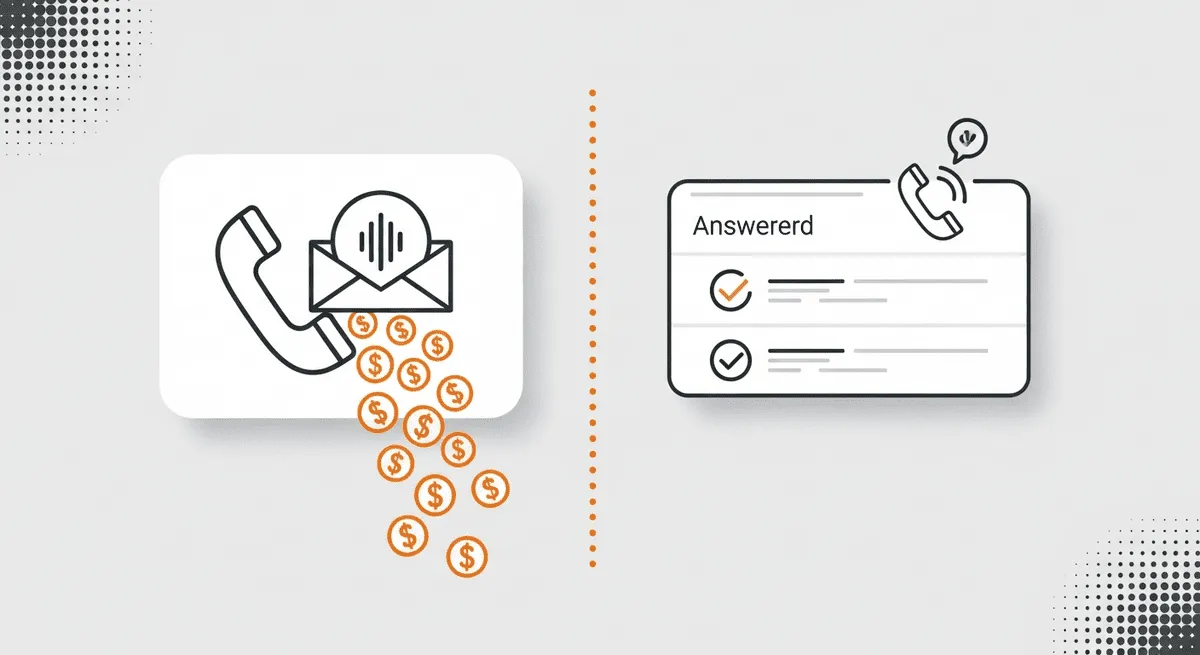
Table of Contents
- The True Cost of Missed Calls: By the Numbers
- How to Calculate Your Own Missed Call Cost
- What Missed Calls Cost by Industry
- Home Services: Up to $60,000 Per Year Lost
- Law Firms: Up to $250,000+ Per Year Lost
- Healthcare and Dental Practices: Losing Patients Before They Walk In
- Real Estate: $75,000+ Per Year in Lost Commissions
- General Small Businesses: $7,500 to $95,000 Per Year
- The Hidden Costs Nobody Talks About
- Customer Lifetime Value Multiplier
- Your Marketing Budget Gets Wasted
- Reputation Damage and Review Loss
- Staff Productivity Drain
- Why Most Small Businesses Miss So Many Calls
- What Callers Do After You Don’t Answer
- How to Stop Losing Revenue to Missed Calls
- Basic Fixes (Limited Impact)
- Human Answering Services (Medium Impact, Higher Cost)
- AI Answering Services (Maximum Impact, Lowest Cost)
- The ROI of Fixing Your Missed Call Problem
Table of Contents
Somewhere in your city right now, a business is losing a customer they’ll never know about. The phone rang. Nobody answered. The caller moved on in less than 30 seconds.
That’s the cost of missed calls in its simplest form: not a refund, not a complaint, not a bad review. Just silence. The phone stops ringing, the caller finds someone else, and your business never knows what it lost.
The numbers behind that silence are significant. Small businesses in the U.S. lose an average of $126,000 per year to unanswered calls, according to AMBS Call Center research. That figure covers direct revenue loss only. The hidden costs, wasted ad spend, reputation damage, and customer lifetime value lost, multiply it considerably.
This guide breaks down the cost of missed calls by industry, explains the psychology behind why callers don’t come back, and walks through exactly what it costs to fix the problem versus what it costs to ignore it.
The True Cost of Missed Calls: By the Numbers
The data on missed calls is unambiguous, and it has been consistent across multiple independent research efforts over the past decade. Here is the baseline picture:
- Small businesses lose an average of $126,000 per year from unanswered calls (AMBS Call Center study)
- Each unanswered call costs $100 to $1,200 in direct revenue depending on industry
- 62% of calls to small businesses go unanswered during regular business hours
- 85% of callers who reach voicemail never call back. They contact a competitor immediately
- 80% of callers who hit voicemail hang up without leaving a message
- 42% of small and mid-sized businesses estimate losing at least $500 per month to missed calls
“85% of callers who reach voicemail hang up without leaving a message. And 85% of those people never call back.”
Those last two statistics together are the real problem. A voicemail system is not a safety net. It is a holding area that most callers never enter and that almost no caller waits in. The moment your phone goes unanswered, the odds of recovering that caller drop to 15% or below.
How to Calculate Your Own Missed Call Cost
Most businesses underestimate how much they are losing because they calculate only the calls they know they missed. The formula changes the picture quickly.
Annual loss = (Daily missed calls × Average job or deal value × Conversion rate) × 250 working days
Here is a concrete example. A plumbing company misses an average of 2 calls per day. Their average job value is $350. They close about 20% of inbound calls. That math: 2 × $350 × 0.20 × 250 = $35,000 per year. And that is only direct revenue. It does not account for customer lifetime value or marketing spend already paid to generate those calls.
Use this quick reference table to estimate your own annual exposure:
| Missed Calls/Day | Avg Job Value | Conversion Rate | Est. Annual Loss |
|---|---|---|---|
| 1 | $250 | 25% | $15,625 |
| 2 | $350 | 20% | $35,000 |
| 2 | $500 | 25% | $62,500 |
| 1 | $1,200 | 20% | $60,000 |
| 1 | $10,000 | 10% | $250,000 |
Most business owners who run this calculation for the first time are surprised by what they find. The number for one missed call per day at modest job values still clears $15,000 annually. At higher-value industries, the picture gets considerably harder to ignore.
What Missed Calls Cost by Industry
A missed call is not a fixed dollar amount. It depends entirely on what your customers are worth. A contractor missing a call loses a different amount than a law firm missing an intake inquiry. Here is the industry-by-industry breakdown.
Home Services: Up to $60,000 Per Year Lost
HVAC companies, plumbers, roofers, and landscaping businesses miss approximately 27% of inbound calls even during peak business hours. That is not for lack of caring. It is because the people who do the work are the same people who would answer the phone, and they cannot do both at the same time.
Average job values in home services run from $300 to $1,200. A plumber missing 2 calls per day at a $350 average job value and 20% close rate is losing roughly $35,000 per year in direct revenue. For HVAC companies where average service calls run $500 to $1,200, that number exceeds $60,000 annually.
Emergency calls hurt the most. A homeowner with a burst pipe or a failed HVAC unit in July is not going to wait for a callback. They are calling the next number immediately. An HVAC answering service that answers instantly captures that job. One that goes to voicemail does not.
Law Firms: Up to $250,000+ Per Year Lost
The cost of missed calls hits law firms harder than almost any other category. Average legal matter values range from $3,000 to $50,000 per case. A firm missing just one qualifying intake call per day at a $10,000 average case value and a 25% conversion rate is losing $62,500 per year in actual revenue.
Legal callers are notably different from other types of callers. They typically research a handful of firms, pick up the phone, and commit to the first one that responds professionally and quickly. They rarely call four firms simultaneously. Missing that call rarely means a callback. It usually means that client went to a competitor.
The math at the high end is sobering. A personal injury firm with $50,000 average case values missing one call per day at 10% conversion is looking at a $250,000 annual exposure. A dedicated answering service for law firms converts that risk into answered calls.
Healthcare and Dental Practices: Losing Patients Before They Walk In
A missed call from a new patient seeking to book an appointment carries two costs. The obvious one is the appointment value: typically $200 to $600 per visit. The less obvious one is the patient lifetime value, which runs $3,000 to $8,000 over a five-year relationship for a general dental patient.
New patients who cannot reach a practice on the first call rarely try again. They book with whoever answers. The same dynamic applies to healthcare practices handling appointment inquiries: same-day cancellations and no-shows compound the problem when new patients could not get through to fill those slots.
A dental answering service handles scheduling and basic inquiries around the clock without requiring staff to be available every minute. For practices concerned about HIPAA compliance, AI answering services can handle scheduling and general inquiries without touching protected health information. The medical answering service category has matured enough to address these compliance needs directly.
Real Estate: $75,000+ Per Year in Lost Commissions
Real estate is a speed business. Research consistently shows a 21x higher likelihood of conversion when a lead receives a response within five minutes versus 30 minutes. An agent at a showing, in a closing, or simply driving between appointments who misses a call from a motivated buyer or seller is not just losing that one inquiry. They are losing the deal.
Average commissions run $8,000 to $15,000 per closed transaction. Two missed calls per day at a 15% conversion rate on an $8,000 average commission = $60,000 in lost annual income. A real estate answering service captures those calls without requiring the agent to be on call every minute of every day.
General Small Businesses: $7,500 to $95,000 Per Year
Even at modest average transaction values of $150 to $500, missing three calls per day adds up to $25,000 to $95,000 per year in lost direct revenue. That range reflects businesses from dry cleaners and tutoring services to auto repair shops and boutique fitness studios.
The bigger multiplier for general SMBs is customer lifetime value. A new customer worth $250 on the first transaction may represent $3,000 to $5,000 over three years of repeat business. Missing that call does not cost $250. It costs the relationship. Research from HubSpot found that 78% of customers buy from the first business that responds to their inquiry, not the best one they researched.
| Industry | Avg Call Value | Annual Loss (2 missed/day) | Call-Back Rate After Miss |
|---|---|---|---|
| HVAC/Plumbing | $350–$1,200 | $8,750–$60,000 | 15% |
| Law Firms | $3,000–$50,000 | $62,500–$250,000+ | 20% |
| Healthcare/Dental | $200–$600/visit | $10,000–$30,000 | 30% |
| Real Estate | $8,000–$15,000 | $40,000–$75,000 | 25% |
| General SMB | $150–$500 | $7,500–$25,000 | 15% |
The Hidden Costs Nobody Talks About
Direct revenue loss is the visible part of the problem. There are four more cost layers that traditional missed call estimates consistently understate, and each one compounds the others.
Customer Lifetime Value Multiplier
The caller who did not get through was not worth one transaction. They represented every transaction they would ever bring to your business, plus every referral they would have made.
A plumbing customer worth $350 today represents $4,500 in repeat service over 10 years if the relationship develops. A legal client worth $10,000 in fees may generate two to three referrals at similar value. The true cost formula is not “missed call value” but rather “missed call value × CLV multiplier of 3 to 10x.” By that math, a single unanswered call from a potential HVAC customer is not a $400 miss. It is a $1,200 to $4,000 miss.
Your Marketing Budget Gets Wasted
Every call your business generates costs money, even if the call itself is free. Google Ads calls average $56 to $73 per call in acquisition cost, according to Invoca research. If your business runs $1,000 per month in paid search and misses 20% of the calls those ads generate, you are wasting $200 per month in ad spend before making a single dollar. That is $2,400 per year in marketing budget producing zero return.
Organic traffic has the same problem, just with a different cost structure. You invested months of SEO effort or paid a content agency to rank your business on Google. A caller finds you, dials your number, gets voicemail, hangs up, and calls your competitor. The content investment still happened. The return on it did not.
Reputation Damage and Review Loss
Callers who cannot reach your business do not stay quiet. A meaningful percentage leave online reviews specifically citing phone accessibility. “Can never get anyone on the phone” and “left me on hold, never answered” show up in 1-star reviews across Google, Yelp, and industry-specific platforms for exactly this reason.
Each negative review costs an estimated $3,000 to $8,000 in lost future revenue when you factor in the reduced conversion rate from lower star ratings. The compounding effect is particularly damaging: missed calls produce bad reviews, bad reviews reduce inbound call volume, reduced volume means fewer opportunities to earn back the business. The cycle feeds itself.
Staff Productivity Drain
An unanswered call does not disappear. It creates work. Someone has to monitor voicemail, attempt a callback, relay messages, and try again when the callback goes unanswered. Studies put the average number of follow-up touchpoints per missed call at 2.3, meaning one missed call creates more than two additional tasks for staff who already have a full day.
After-hours missed calls are particularly disruptive. They accumulate overnight and arrive as a stack of callback tasks first thing in the morning, directly competing with scheduled work for the day. Staff who start each day clearing voicemail and chasing callbacks are not at their most productive, and those tasks are not the most valuable use of their time.
Why Most Small Businesses Miss So Many Calls
Missed calls are not a people problem. They are a capacity and process problem. Understanding why they happen is the first step toward solving them structurally.
Lunch breaks and peak-hour overflow. Most businesses have predictable call spikes around 11 AM to 1 PM and again from 4 to 6 PM. These coincide exactly with lunch breaks and end-of-workday inquiry surges. A single receptionist handling another call cannot also answer the next one.
After-hours volume. Roughly 30% of calls to small businesses arrive outside of standard operating hours. For businesses without an after-hours answering service, that is a 100% miss rate for a full third of their inbound call volume.
Single-person reception. Most small businesses have one person managing inbound calls. One person on another call means the next caller goes unanswered. There is no backup.
The work-at-the-front problem. Contractors, plumbers, dentists, and HVAC technicians are at their most productive when they are working, not when they are at a desk waiting for the phone to ring. Their best billable hours are the hours they are least available to answer calls.
No automated backup. Without overflow routing, voicemail-to-text, or an AI backup system, every coverage gap becomes a lost call. One missed call is an accident. A predictable pattern of missed calls is a process gap.
It is worth recognizing that none of these are failures of effort or work ethic. A plumber who misses calls while running a four-hour drain job is not negligent. A dentist who doesn’t answer between 2 PM and 3 PM while with patients is not cutting corners. The problem is structural: they are running businesses designed for a 40-hour week that receive calls all 168 hours. The gap between those two numbers is where the revenue leaks.
The 5 most common times your business misses calls:
- Lunch hour (12 PM to 1 PM)
- Weekday evenings (5 PM to 9 PM)
- Weekends
- When your receptionist is on another call
- Holidays and PTO days
What Callers Do After You Don’t Answer
The missed call itself is a single moment. What happens in the 60 seconds after that moment determines whether you have lost that customer permanently.
The data on caller behavior after an unanswered call is consistent and stark:
- 85% never call back. They move on immediately. Not after a few minutes, not after sending a text. They call the next option right away.
- 80% don’t leave voicemails. The idea that voicemail serves as a safety net is largely a myth. Four out of five callers who reach your voicemail hang up without leaving a message.
- 78% buy from the first business to respond. Not the highest-rated, not the most experienced, not the one they originally preferred. The first one that answers.
- 67% of people ignore voicemails. Of the 20% of callers who do leave a voicemail, a majority admit they don’t realistically expect a timely callback.
- Businesses that respond within one minute see a 391% increase in conversion compared to those who respond within five minutes.
“78% of customers buy from the first business that responds to their inquiry. Not the best business. The first one.”
There is an emotional dimension here too. Callers who cannot reach a business feel dismissed. That feeling does not evaporate when they find another provider. It often shows up in reviews and in conversations with friends and colleagues. The cost of a missed call extends beyond the transaction.
How to Stop Losing Revenue to Missed Calls
Now that the problem is quantified, here are the solutions available to businesses at different stages, ranging from quick workarounds to complete coverage.
Basic Fixes (Limited Impact)
Call forwarding to mobile. Reduces misses during breaks and off-site hours, but creates real work-life balance friction. The business owner’s personal phone becomes a 24/7 work phone by default. It does not scale when call volume increases, and it does not help when the owner is already on a call.
Shared team numbers. Helps with overflow by distributing the load, but requires coordination and can create confusion over ownership of callbacks. It also doesn’t solve after-hours gaps.
Voicemail-to-text transcription. Improves the callback workflow slightly since staff can scan transcripts without listening to audio. But remember: 80% of callers aren’t leaving a voicemail in the first place. Transcribing messages you never receive doesn’t solve much.
Better voicemail greeting. Encourages callbacks and sets expectations about response time. Worth doing regardless. But with 80% of callers hanging up before the beep, it only helps the minority who stay on the line.
Human Answering Services (Medium Impact, Higher Cost)
Traditional answering services run $135 to $400 per month and deploy live operators to answer on your behalf. Virtual receptionists are a step above that, typically $200 to $500 per month, with higher quality interactions and more sophisticated call handling. For a full picture of what these options actually cost at each tier, the cost of an answering service guide breaks down specific pricing across major providers.
These services solve the core problem, but come with real limitations. Agent quality varies across shifts and operators. Holiday and after-hours surcharges add to the monthly cost. Scaling up call volume means scaling up cost linearly. And a virtual receptionist operating on business hours still leaves after-hours calls unanswered.
The comparison also changes when you account for what human receptionist staffing actually costs. At $55,000 to $62,000 per year fully loaded (the true cost of a full-time hire detailed in the cost of a full-time receptionist), even premium answering services are a fraction of the staffing alternative.
AI Answering Services (Maximum Impact, Lowest Cost)
An AI answering service like Synvola answers every call, 24/7/365, in under two seconds. No lunch breaks, no holidays, no wait while another call finishes. The cost runs $49 to $200 per month, a fraction of both human answering services and the revenue at risk.
What a modern AI answering service handles on every call:
- Schedule appointments directly into your calendar system
- Answer common FAQs about your hours, services, and pricing
- Qualify inbound leads by asking the right questions
- Route urgent calls to your on-call team immediately
- Capture name, phone, intent, and urgency for every caller
There are no after-hours surcharges, no holiday premiums, and no per-minute rounding that inflates the bill at month’s end. For small businesses where an answering service for small businesses is the right fit, the economics are straightforward.
The ROI calculation at $49/month is also simple: recovering one missed call at $500 value in a month covers the entire subscription cost with $451 left over. To try it yourself, call our demo line at (917) 324-8401 and hear exactly how Synvola handles an inbound inquiry.
| Solution | Monthly Cost | Coverage | Answer Rate | Setup Time |
|---|---|---|---|---|
| Call forwarding to mobile | $0 | Limited | ~60% | Minutes |
| Voicemail-to-text | $10–$30 | 24/7 | 0% live | Minutes |
| Traditional answering service | $135–$400 | Business hours+ | ~95% | 1–2 weeks |
| Virtual receptionist | $200–$500 | Expanded hours | ~98% | 1 week |
| AI answering service (Synvola) | $49–$200 | 24/7/365 | 100% | Same day |
The ROI of Fixing Your Missed Call Problem
Here is the framing that most business owners find useful: a $49/month answering service is not an expense. It is a hedge against a $35,000 per year revenue problem.
The ROI formula is straightforward: (Value of one recovered call per month × 12) ÷ Annual subscription cost = annual ROI
Three examples, starting from the briefest’s most realistic scenarios:
HVAC company. $49/month Synvola plan. Average job value $450. Conversion rate 25%. Recovering just one extra call per month = $450 recovered. Monthly ROI: 818%. Payback period: Day 1.
Law firm. $99/month plan. Average intake value $8,000. Conversion rate 15%. One recovered intake call per month = $1,200 recovered on average. Monthly ROI: 1,112%. A single qualified intake pays for the subscription for an entire year.
Dental practice. $49/month plan. Average new patient value $1,200 over their first year. One recovered new patient booking per month = $1,200 recovered. Monthly ROI: 2,347%.
The $126,000/year average loss puts the scale of the problem in context. A $588/year AI answering service recovering even 1% of that figure = $1,260 recovered. Net annual gain: $672 at minimum. At 5% recovery: $5,712 net gain. At 20% recovery: nearly $24,000 net.
“An AI answering service that costs $49/month pays for itself the moment it captures a single missed call.”
To see current plan pricing and what each tier covers, Synvola’s pricing page lays it out without hidden fees.
Sources: AMBS Call Center Missed Call Research, Invoca Call Analytics Benchmark Report, HubSpot Lead Response Management Study, Harvard Business Review on review revenue impact. Statistics reflect small business data published 2022–2025. Last updated April 2026.

Senior Content Strategist
Senior Content Strategist at Synvola. 8+ years in B2B SaaS content, specializing in AI communication and small business growth.