Dental Answering Service vs AI Receptionist: Which One Actually Works for Your Practice?
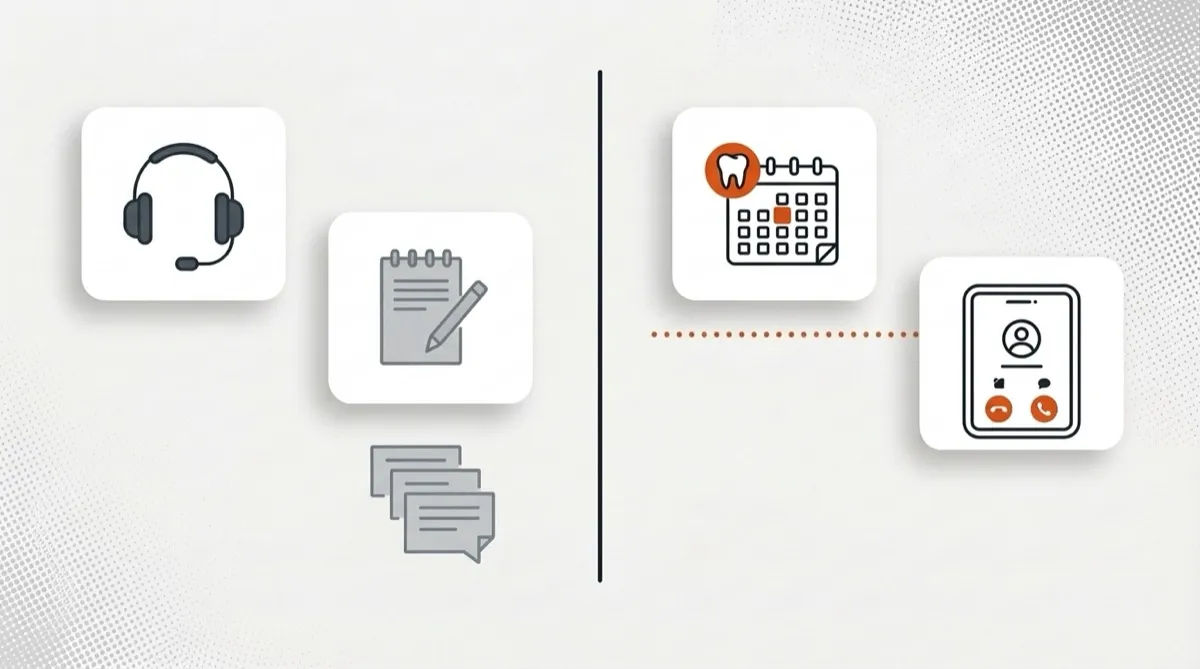
Table of Contents
- What Is a Dental Answering Service?
- What Is an AI Receptionist for Dental Offices?
- Head-to-Head Comparison: 7 Dimensions That Matter
- Cost Comparison
- Appointment Booking and Scheduling
- After-Hours and Weekend Coverage
- PMS Integration
- HIPAA Compliance and Data Security
- Patient Experience and Call Quality
- Consistency and Reliability
- When a Dental Answering Service Still Makes Sense
- When an AI Receptionist Is the Clear Winner
- How to Switch from an Answering Service to AI
Table of Contents
Your dental practice misses 30-40% of inbound calls. That is not a guess. It is what the data shows across practices of every size, from solo practitioners to 10-chair DSOs. The question is not whether you need help answering those calls. The question is which kind of help actually solves the problem.
On one side, traditional dental answering services: remote human operators who pick up your phone, take a message, and relay it to your front desk. On the other, AI receptionists: automated voice agents that book appointments directly into your practice management software and operate around the clock without coffee breaks or holiday pay.
The dental answering service vs ai receptionist debate comes down to cost, appointment booking, PMS integration, after-hours coverage, HIPAA compliance, and patient experience. This guide compares the two on every dimension with real pricing data and honest verdicts. Not every practice needs AI, and not every practice should stick with a traditional service. By the end, you will know which one fits yours.
What Is a Dental Answering Service?
A dental answering service is a remote call center staffed by human operators who answer your phones when your front desk cannot. You forward calls to them during lunch breaks, after hours, or when call volume spikes beyond what your in-house team can handle.
The operators follow scripts you provide. A patient calls to schedule a cleaning, and the operator writes down their name, phone number, and reason for calling. That message gets emailed or texted to your office. Your staff calls the patient back when they have a free moment. If it is an emergency, the operator follows an escalation script and contacts the on-call dentist.
Common providers in this space include Stericycle Communications (formerly MedCall), PatientCalls, and AnswerConnect. Most of them handle dental and medical practices as part of a broader healthcare answering portfolio. For a closer look at specific providers, our guide to the best dental answering services covers the top options.
The billing model is almost always usage-based. You pay per minute ($1.50 to $3.00 per minute of talk time) or per call ($5 to $12 per call). A typical dental practice handling 200 to 400 calls per month pays $800 to $2,400 per month before after-hours surcharges and holiday premiums kick in.
The core limitation: these operators cannot access your schedule. They cannot book appointments, check availability, verify insurance, or look up patient records. Every call becomes a two-step process. The operator takes the message. Your staff processes it later. That gap is where patients fall through the cracks.
What Is an AI Receptionist for Dental Offices?
An AI dental receptionist is a voice agent trained on dental terminology and workflows. It answers your phone calls, holds natural conversations with patients, books appointments in real time, and handles the routine questions your front desk answers fifty times a day: office hours, insurance acceptance, directions, procedure costs, what to expect before a crown prep.
The technology uses natural language processing tuned for dental vocabulary. It knows the difference between a prophylaxis and a perio maintenance appointment. It understands that “my tooth hurts really bad” is an emergency, not a routine scheduling request.
What separates an AI dental receptionist from a generic chatbot is PMS integration. The AI connects directly to Dentrix, Eaglesoft, or Open Dental. When a patient calls to schedule, the AI checks real-time availability, matches the right appointment type, books the slot, and sends the patient an SMS confirmation. No callback needed. No message relay. No delay.
Synvola’s virtual receptionist is one example. It handles scheduling, rescheduling, cancellations, FAQ responses, emergency triage, and bilingual calls for a flat monthly fee. Other AI receptionist providers include Arini, Dentistry.AI, and My AI Front Desk.
The billing model is fundamentally different from traditional answering services. Most AI receptionists charge a flat monthly rate between $49 and $300 per month regardless of call volume. No per-minute charges. No after-hours surcharges. No holiday premiums. Synvola starts at $49/month for 60 calls with 24/7 coverage included.
Head-to-Head Comparison: 7 Dimensions That Matter
These are the seven factors dental practice owners ask about most when evaluating their options. Each dimension includes a clear verdict based on what the numbers and operational realities actually show.
Here is the quick-reference table before we break each one down:
| Dimension | Dental Answering Service | AI Receptionist |
|---|---|---|
| Cost | $250-$1,200+/mo (volume-based) | $49-$300/mo (flat rate) |
| Appointment Booking | Message-taking only | Books directly into PMS |
| After-Hours Coverage | Premium pricing (1.5-2x) | Included, no extra cost |
| PMS Integration | None | Dentrix, Eaglesoft, Open Dental |
| HIPAA Compliance | Varies by provider | Built-in, auditable |
| Patient Experience | Hold times, callbacks | Instant answer, no wait |
| Consistency | Varies by operator | Same quality every call |
Cost Comparison
Traditional dental answering services bill by usage. Per-minute rates run from $0.95 to $3.00, and per-call rates land between $5 and $12. For a mid-size dental practice handling 200 calls per month, the monthly bill sits between $800 and $2,400. Add setup fees ($50 to $200 one-time), holiday surcharges (1.5x to 2x the normal rate), and after-hours premiums, and the real cost climbs higher.
AI receptionists charge a flat monthly fee. No per-minute billing. No per-call surprises. Synvola’s pricing starts at $49/month for 60 calls with 24/7 coverage, and higher tiers include unlimited calls.
The annual math tells the story. A dental answering service at $1,200/month runs $14,400 per year. An AI receptionist at $99/month costs $1,188 per year. That is $13,212 in annual savings for comparable (actually superior) coverage.
Watch for hidden fees too. Many answering services round minutes upward. A 15-second call to confirm an appointment gets billed as a full minute. At $2.50/min, those short calls waste real money. Add minimum call durations, contract lock-ins with early termination penalties, and CRM integration add-ons, and the advertised price becomes fiction. For a deeper breakdown, our answering service pricing guide covers the full cost landscape, and the virtual receptionist pricing guide compares flat-rate vs per-minute models in detail.
Verdict: AI wins on cost by 5-10x for comparable coverage. Not close.
Appointment Booking and Scheduling
This is where the gap between the two options becomes obvious.
A dental answering service takes a message. “The patient wants to schedule a cleaning.” Your front desk staff reads that message the next morning, calls the patient back, checks the schedule, and tries to book the appointment. If the patient does not answer the callback, you play phone tag. Meanwhile, the patient may have already booked with the office down the street that had a faster process.
An AI receptionist books the appointment during the original call. It checks real-time availability in your PMS, matches the right appointment type (hygiene, restorative, emergency), confirms the slot with the patient, and sends an SMS confirmation immediately. No callback. No delay. No lost patient.
The impact is measurable. Practices using AI booking capture 20-30% more appointments because there is zero delay between the patient’s request and the confirmation. Rescheduling and cancellations work the same way. The AI handles them in real time and fills open slots immediately instead of leaving your schedule full of gaps.
Verdict: AI wins decisively. This is the single biggest differentiator between the two options.
After-Hours and Weekend Coverage
Between 25% and 35% of calls to dental practices come outside business hours. Evenings, weekends, lunch breaks. These are patients calling when they have time to call, which rarely aligns with when your front desk is staffed.
Dental answering services handle after-hours calls, but at premium rates. The standard after-hours surcharge is 1.5x to 2x the daytime rate. Weekend coverage costs even more. A practice paying $1.00/minute during the day might pay $2.00/minute after 6 PM and $2.50/minute on Saturdays.
An AI receptionist provides the same quality of service at 2 AM as it does at 10 AM. No surcharges. No overtime. No premium tiers. Twenty-four-seven coverage is included in the base price because it costs the provider nothing extra to keep the AI running overnight.
Emergency triage is where the consistency advantage compounds. A patient calls Saturday morning with a broken crown. The AI receptionist triages the urgency based on a defined protocol, books a Monday emergency slot, texts the on-call Dr. Kim with full caller details, and sends the patient an SMS confirmation with next steps. Every time. The same protocol. No variation.
An answering service takes a message. The patient waits for a callback. If the on-call operator is new or undertrained, the urgency assessment may be off. Synvola’s after-hours answering service handles this exact scenario without premium pricing.
Verdict: AI wins. Same quality around the clock, no premium pricing.
PMS Integration
This is where the gap between the two options is widest. Traditional dental answering services have zero integration with your practice management software. The operator cannot check your schedule, cannot verify insurance, cannot pull up a patient record. They operate blind.
AI receptionists integrate with the three major dental PMS platforms: Dentrix (Henry Schein), Eaglesoft (Patterson), and Open Dental. Some also connect to Curve Dental, Denticon, and tab32.
That integration enables real-time availability checks, patient record lookup (existing patient vs new patient routing), insurance verification awareness, and appointment type matching (hygiene vs restorative vs emergency vs cosmetic consultation). The AI is not guessing. It is reading your actual schedule and booking accordingly.
Without PMS integration, every call becomes a two-step process: (1) the answering service takes a message, (2) your staff processes that message. This doubles the work and defeats the entire purpose of outsourcing phone coverage. Your front desk ends up doing the same scheduling tasks they always did, just with a time delay added.
For dental practices running on Open Dental or Dentrix, PMS integration is the factor that transforms a virtual receptionist from a glorified notepad into an actual scheduling tool. See our dental industry page for how Synvola’s AI dental receptionist integrates with these systems.
Verdict: AI wins. PMS integration is the structural advantage that answering services cannot match.
HIPAA Compliance and Data Security
Dental practices are covered entities under HIPAA. Any service that handles patient calls on your behalf must comply with federal privacy regulations. This is not optional, and the penalties for violations are severe.
Traditional answering services vary widely on compliance. Reputable providers sign Business Associate Agreements (BAAs) and train their operators on PHI handling protocols. But human operators remain the number one source of HIPAA breaches in outsourced call handling. An operator writes patient details on a physical notepad. A screen stays unlocked during a break. Patient information gets discussed in a shared call center floor with operators handling calls for different medical practices simultaneously.
AI receptionists are HIPAA-compliant by design. No human operator touches patient information. Data is encrypted in transit and at rest. Call logs are audit-ready. BAAs are standard. The compliance architecture is built into the software rather than trained into human behavior.
Before choosing either option, ask the right questions. For an answering service: request the BAA and ask about breach history. For an AI receptionist: verify SOC 2 certification and data retention policies.
Verdict: AI has the structural advantage because it removes the human variable. Both can be HIPAA-compliant when properly implemented, but AI carries lower breach risk.
Patient Experience and Call Quality
A dental answering service puts patients on hold during peak hours when the call center is overloaded with calls from multiple clients. Different operators have different levels of dental knowledge. Patients often need to repeat information they have already provided. And the operator cannot answer most practice-specific questions. “Does Dr. Smith do implants?” “What does a crown cost?” “Do you accept Delta Dental?” The operator has no idea. They take a message.
An AI receptionist answers instantly. No hold time. Consistent responses on every call. The AI is trained on your practice’s specific FAQ library, your providers, your procedures, your insurance list. It can answer the questions that answering service operators simply cannot.
The most common objection to AI is “patients want to talk to a real person.” For some calls, that is true. But most dental calls are routine: scheduling, rescheduling, checking hours, verifying insurance. For these, patients care about speed and accuracy, not a warm conversation about their weekend.
For emotionally complex calls (treatment anxiety, billing disputes, complaints), human empathy matters. An AI receptionist handles this by warm-transferring to your staff with a complete summary, so the patient does not repeat their story.
Verdict: AI wins for routine calls, which represent 80-85% of dental call volume. Humans win for the 15-20% that require genuine empathy.
Consistency and Reliability
Call centers have turnover rates averaging 30-40% annually. Each new operator needs training on your practice’s protocols, hours, and providers. Quality varies by shift, by day, by individual. The Monday morning operator might be excellent. The Friday evening substitute might be brand new.
An AI receptionist gives the same response quality on call number one as call number five hundred. It never has a bad day. It never forgets that your office is closed on the second Friday of every month. It never misquotes your cleaning prices or tells a patient you accept an insurance plan you dropped six months ago.
For DSOs and multi-location practices, consistency across all offices is critical. AI delivers identical service quality at every location. A dental answering service might assign different operators to different locations, and the experience diverges.
Verdict: AI wins. Consistency is built into the architecture, not trained into fallible humans.
When a Dental Answering Service Still Makes Sense
Being honest about this matters. There are real scenarios where a traditional answering service is the better choice.
Very low call volume. If your practice handles fewer than 30 calls per month, per-call pricing from an answering service might actually be cheaper than a flat AI subscription. At $5 per call and 25 calls per month, you are paying $125. Some AI plans start at $49, but others charge $99 or more. Do the math for your specific volume.
Complex patient conversations. Treatment plan discussions, billing dispute resolution, and deeply anxious patients benefit from human empathy that AI cannot replicate. A patient calling in tears because they need a root canal and cannot afford it needs a human on the other end.
Elderly patient populations. Some practices serve communities where a significant portion of patients are elderly and strongly prefer speaking to a real person. Forcing AI on this demographic can create friction that outweighs the operational benefits.
Temporary coverage. If you are hiring a new receptionist and need 4-6 weeks of bridge coverage, an answering service provides that without a long-term commitment.
The hybrid model. Some practices use AI for after-hours and overflow calls, then rely on their in-house staff (or a human answering service) for complex conversations during business hours. This gives you the best of both approaches.
The wrong choice is not picking a human service over AI. The wrong choice is letting calls go to voicemail while you decide. Voicemail is where dental patients go to call the next practice on their list.
When an AI Receptionist Is the Clear Winner
For most dental practices, the math and the operational advantages point clearly toward AI. Here are the scenarios where the decision is straightforward.
High call volume practices (100+ calls/week). Flat-rate pricing saves thousands per year compared to per-minute or per-call billing. The more calls you handle, the wider the cost gap becomes.
After-hours demand. If 25-35% of your calls come outside business hours, paying premium rates for human coverage destroys your budget. AI charges the same flat rate at midnight as it does at noon.
Appointment-heavy workflows. Direct PMS booking eliminates the callback loop that loses patients. Every call that books during the first contact is a patient your practice keeps.
Multi-location practices and DSOs. Consistent experience across every office without training separate operator teams. Scale without scaling headcount.
Growth-phase practices. Adding a second or third chair should not mean hiring another receptionist just to handle the phone volume increase. AI scales with your growth.
Bilingual patient populations. AI auto-detects language and switches without a phone tree or a “press 2 for Spanish” prompt. Synvola’s AI answering service handles English and Spanish natively.
Overwhelmed front desks. During morning rushes and post-lunch scheduling blocks, your in-house staff is handling patients in the office. AI picks up the overflow so no call goes to voicemail.
How to Switch from an Answering Service to AI
If you are currently using a dental answering service and considering the switch, here is the practical migration path that minimizes risk and disruption.
Step 1: Audit your call data. Pull your last 3 months of invoices. Count total calls per month, after-hours percentage, most common call types, and average cost per call. These numbers become your baseline.
Step 2: Run both services in parallel. Set up the AI receptionist alongside your current answering service for 2-4 weeks. Route after-hours calls to AI first. Keep your answering service as the daytime backup.
Step 3: Train the AI on your practice. Feed it your office hours, provider names, procedure menu, insurance plans, emergency protocol, and common patient questions. See how Synvola works for details on the setup process.
Step 4: Monitor and adjust. Review AI call transcripts daily for the first week, then weekly. Flag calls where the AI gave incorrect information. Most platforms let you update training in real time.
Step 5: Expand AI to handle overflow. Once you trust the after-hours quality, route overflow calls during busy periods. Monday morning rushes and post-lunch scheduling blocks are ideal starting points.
Step 6: Cancel your answering service. Once AI is handling the volume reliably, terminate your answering service contract. Keep their number on file for emergency backup during PMS outages.
Timeline: Most practices complete the transition in 30-60 days. Setup and training take the first week. Weeks two through four are parallel operation. By week five, AI handles the full volume.

Industry Research Analyst
Industry Research Analyst at Synvola. 6+ years researching AI adoption in dental, legal, and healthcare verticals.