Ruby Receptionist vs Synvola: Honest Pricing and Feature Comparison (2026)
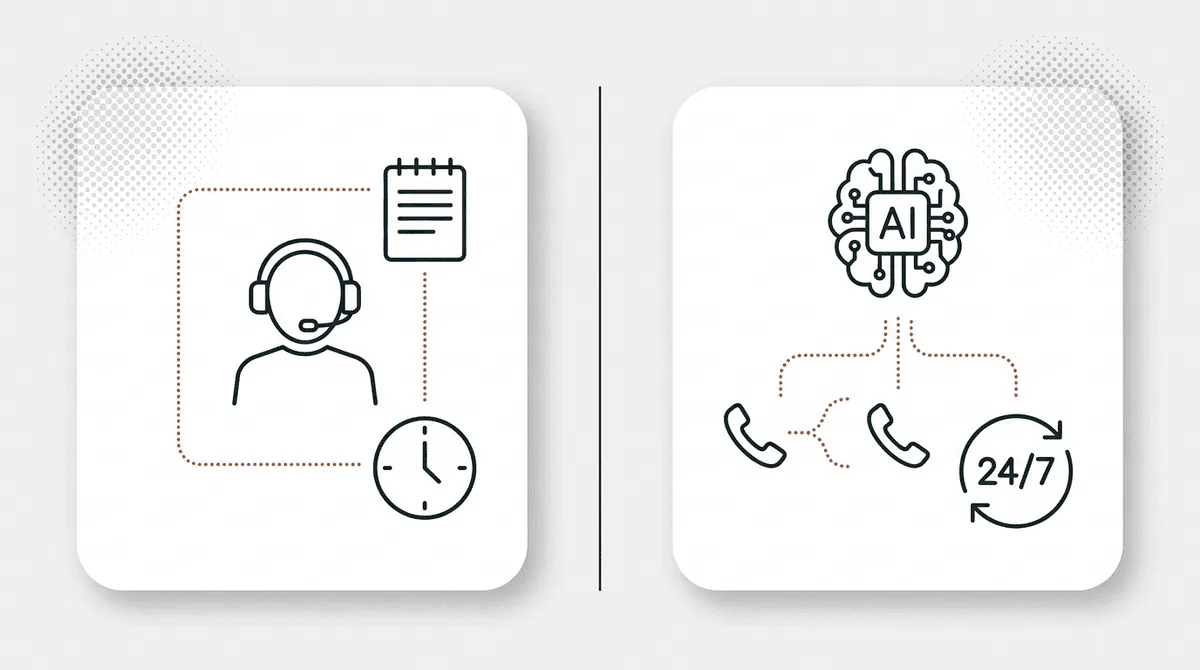
Table of Contents
- What Is Ruby Receptionist?
- Ruby Receptionist Pricing: What You Actually Pay
- Ruby’s Pricing Plans (2026)
- What 100 Minutes of Ruby Actually Gets You
- Synvola Pricing: Flat-Rate AI Answering Service
- Ruby Receptionist vs Synvola: Full Comparison
- Ruby Receptionist: Pros and Cons
- The Real Cost Comparison: Ruby vs Synvola at Different Call Volumes
- When Ruby Receptionist Is Still Worth It
- When Synvola Makes More Sense Than Ruby
- Ruby Receptionist vs Synvola: The Bottom Line
Table of Contents
Ruby Receptionist is one of the most established live virtual receptionist services in the country, founded in 2003 with over 15,000 small business clients. Synvola is a purpose-built AI answering service at a fraction of the cost. Different tools, different trade-offs, very different price tags.
This comparison is for small business owners evaluating Ruby before signing up, or current Ruby customers questioning whether the monthly cost is justified. We’ll cover the real pricing, what you actually get for the money, and which service fits which situation.
The short version: Ruby Receptionist starts at $235/month for 50 minutes of live receptionist time, roughly $4.70 per minute, with overage charges if you exceed your plan. Synvola starts at $49/month as a flat-rate AI answering service with no per-minute billing and no overage fees. For most small businesses handling routine calls, Synvola costs 80% less while covering 100% of call volume 24/7.
Set expectations: this article covers Ruby receptionist pricing in detail, features, setup, and which service makes sense for which type of business.
What Is Ruby Receptionist?
Ruby was founded in 2003 in Portland, Oregon, and has built a reputation as one of the most respected ruby virtual receptionist services available. Their model is straightforward: 100% US-based, highly trained human receptionists answer your business calls on your behalf, following your specific call handling instructions, FAQs, and preferences.
The ruby virtual receptionist service covers call answering and screening, warm transfers, message taking, lead capture and intake, appointment scheduling, and outbound calls. Bilingual support in English and Spanish is available, though not across all hours or plans. Ruby also handles spam call filtering, provides AI-generated call transcripts, and offers sentiment analysis on calls.
On the integrations side, Ruby connects to Clio (built specifically for legal practices), HubSpot, Zapier, Grasshopper, Rocket Matter, MyCase, and Nextiva. HIPAA-compliant options are available for healthcare practices.
Ruby’s marketing positioning centers on “genuine human connection” and “relationships that grow your business.” That framing is accurate. What their receptionists do well, they do genuinely well. It’s worth understanding what you’re paying for before comparing it to an AI service.
Ruby competes on human warmth, training quality, and relationship-building, not on price. For some businesses, that’s exactly what they need. For others, the ruby answering service pricing is an expensive premium on a job that AI handles reliably at $49/month.
Ruby Receptionist Pricing: What You Actually Pay
This is the section most readers skip to. Ruby’s pricing structure is worth understanding in detail because the advertised numbers and the real numbers aren’t the same thing.
Ruby’s Pricing Plans (2026)
Ruby uses per-minute pricing across four tiers:
| Plan | Minutes Included | Monthly Price | Cost Per Minute |
|---|---|---|---|
| Starter | 50 min/mo | $235/mo | $4.70/min |
| Core | 100 min/mo | $375/mo | $3.75/min |
| Pro (Most Popular) | 200 min/mo | $680/mo | $3.40/min |
| Premier | 500 min/mo | $1,725/mo | $3.45/min |
The minute allotments sound generous until you understand what “minutes” actually means. Each call consumes receptionist time in minutes. A typical business call runs 3 to 5 minutes, which means 100 minutes equals roughly 20 to 33 calls handled per month. That’s a narrow window for an active small business.
Overage charges apply when you exceed your monthly minutes. Ruby does not publish overage rates on their pricing page. Based on user reports and industry data, the overage rate runs approximately $2.25 to $2.75 per minute beyond plan limits. There are no advance alerts when you’re approaching your ceiling. Your bill can spike without warning during a busy week.
One detail that catches people off-guard: Ruby charges 30 seconds of minutes for hang-ups and for spam calls that pass through their filter. Robocalls, wrong numbers, and dead-air calls all count against your plan. For a full breakdown of how answering service answering service cost structures compare across providers, that guide covers the full landscape.
A 14-day risk-free trial is available on all plans.
What 100 Minutes of Ruby Actually Gets You
The math here matters. Ruby’s Core plan at $375/month includes 100 minutes of receptionist time.
If your calls average 5 minutes each: that’s 20 calls handled per month, or $18.75 per call.
If your calls average 3 minutes each: that’s 33 calls handled per month, or $11.36 per call.
For a business receiving 80 calls per month, 100 minutes is nowhere near enough. You need the $680 Pro plan, and depending on call length, you may still hit overages during a busy month. A single promotional campaign, a media mention, or a seasonal rush can push you from the Core plan into overage territory with no warning.
Synvola Pricing: Flat-Rate AI Answering Service
Synvola’s AI receptionist starts at $49/month. That’s a flat rate covering 24/7 AI answering service with no per-minute billing and no overage fees. One number on your invoice, every month.
The base plan handles 60 calls per month. Call volume beyond that is covered at the same flat rate. No surprise bills. No tiered overages. No anxious arithmetic at the end of the month.
The core job list looks identical to Ruby’s: answering every call 24/7, qualifying leads, taking messages, routing urgent calls via SMS, scheduling appointments, and filtering spam calls automatically. Spam and robocalls are handled before they hit your account, at no cost. As a pure-AI answering service, Synvola picks up in under 5 seconds on every call, simultaneously.
No setup fee. No onboarding charge. No annual contract. 14-day free trial included.
The practical difference from Ruby’s pricing model: Synvola’s cost does not change based on call volume. A quiet month and a busy month look the same on your invoice. Ruby’s cost scales directly with every minute your calls consume.
Ruby Receptionist vs Synvola: Full Comparison
Ruby and Synvola cover the same core job, but they’re built differently in almost every other way. This table covers the dimensions that matter most for small business buying decisions.
| Feature | Ruby Receptionist | Synvola |
|---|---|---|
| Pricing model | Per-minute, 4 tiers | Flat-rate, $49/mo |
| Starting price | $235/month (50 min) | $49/month |
| Calls included | ~10–17 calls (50 min) | 60 calls |
| Overage charges | Yes, per minute ($2.25–$2.75/min) | No overages |
| 24/7 availability | Yes (human) | Yes (AI) |
| After-hours premium | On some plans | No |
| Bilingual support | English + Spanish | English (Spanish in development) |
| Receptionist type | Human (US-based) | AI (answers in under 5 seconds) |
| Appointment scheduling | Yes (all plans) | Yes |
| Lead capture / intake | Yes | Yes |
| Payment processing | Yes | No |
| HIPAA compliance | Yes (healthcare option) | No |
| Spam call filtering | Basic filter | Automatic AI filtering |
| Integrations | Clio, HubSpot, Zapier, 20+ | Zapier, webhook |
| CRM sync | Via Zapier/native integrations | Via Zapier |
| Setup time | Hours to days (onboarding required) | Minutes (self-serve) |
| Contract required | No | No |
| Free trial | 14 days | 14 days |
| Mobile app | Yes | Yes |
The verdict in plain terms: Ruby Receptionist costs 5 to 14 times more than Synvola depending on call volume. For businesses receiving 50 or more calls per month, the cost gap is significant. Ruby’s 200-minute Pro plan at $680/month handles roughly 40 to 65 calls, while Synvola’s $49/month plan handles 60 calls with no overage risk. The core trade-off is human warmth and complex-call handling on Ruby’s side versus cost predictability and 24/7 AI consistency on Synvola’s side.
For a broader look at how Synvola compares across the answering service for small businesses market, that page covers the full context.
Ruby Receptionist: Pros and Cons
Pros:
- Genuine human receptionists who learn your business, recognize repeat callers, and handle emotionally nuanced conversations
- 100% US-based team with high training standards and consistently strong quality scores
- HIPAA-compliant options for medical and healthcare practices
- Native integrations with Clio and other legal and professional software
- All core features (scheduling, lead capture, outbound calls) included in every plan with no feature gating
- Over 20 years of operational history with 15,000+ businesses trusting the service
- Bilingual support in English and Spanish available across plans
Cons:
- Per-minute pricing is expensive and unpredictable, with bills that spike during busy periods and no advance warning
- The Pro plan at $680/month (most popular) handles roughly 40 to 65 calls per month, not unlimited
- Overage rates are not published on the pricing page; users report $2.25 to $2.75/minute
- 30-second minimum charge for hang-ups and spam calls that pass the filter
- Ruby faced a $12 million class action settlement in 2021 related to billing practices. Worth knowing before committing.
- Following a 2023 ownership change, some longtime users report quality inconsistencies
- Onboarding requires time investment and is not self-serve in the first few days
The Real Cost Comparison: Ruby vs Synvola at Different Call Volumes
This is where the pricing model difference becomes undeniable. The table below uses four realistic SMB call volumes and shows what the ruby answering service actually costs at each level versus Synvola’s flat rate.
| Monthly Call Volume | Ruby Plan Needed | Ruby Monthly Cost | Synvola Monthly Cost | Monthly Savings | Annual Savings |
|---|---|---|---|---|---|
| 20 calls/mo | Starter (50 min) | $235 | $49 | $186 | $2,232 |
| 50 calls/mo | Core to Pro ($375–$680) | ~$550 avg | $49 | $501 | $6,012 |
| 100 calls/mo | Pro to Premier ($680–$1,725) | ~$1,200 avg | $49 | $1,151 | $13,812 |
| 200+ calls/mo | Premier ($1,725+) | $1,725+ | $49 | $1,676+ | $20,112+ |
A note on the math: Ruby’s per-minute model means calls averaging 4 to 5 minutes burn through 200 to 250 minutes for 50 calls, pushing many businesses onto higher plans than they anticipated. The Starter plan’s 50 minutes is genuinely only enough for a business receiving 10 to 17 calls per month.
Ruby’s per-minute model means a single busy week during a promotion, a media mention, or a seasonal surge can push you into a higher tier or trigger expensive overage charges. Synvola’s flat rate doesn’t change regardless of call volume. Plan accordingly.
Note on billing history: Ruby settled a $12 million class action lawsuit in 2021 related to billing practices. This is publicly documented and worth factoring in when evaluating any service where unexpected charges are a risk. The company has since updated billing disclosures, but unpublished overage rates remain a concern for businesses on tight budgets.
When Ruby Receptionist Is Still Worth It
Ruby’s human receptionists genuinely excel in scenarios where AI has real limits. This section exists because being honest about it matters, and because businesses in these categories are likely not the right fit for Synvola.
- Premium professional services where the caller experience is a core part of the brand. Luxury law firms, high-end medical practices, and wealth management offices where clients expect human warmth from first contact.
- Emotionally sensitive calls. Grief counseling practices, elder care facilities, crisis support services, and any context where a caller’s distress level requires a human to read the room. AI handles intake steps; it doesn’t handle grief the way a trained person can.
- Complex, off-script intake. Personal injury law firms, insurance claim intake, and medical practices with branching 20-question intake processes that require real judgment at each step. Ruby’s trained receptionists adapt mid-intake in ways AI doesn’t.
- HIPAA-regulated environments where certified live staff and full compliance documentation are required. Ruby’s healthcare options provide this; Synvola is not HIPAA-certified.
- High-stakes outbound calls. When a human representing your firm needs to make relationship-building or follow-up calls, Ruby’s agents are capable of that in ways no AI service replicates currently.
If your business receives under 50 calls per month, Ruby’s Starter or Core plan may be financially feasible, though still expensive per call. And if your brand is built around the warmth of live human service, a ruby virtual receptionist is genuinely hard to replace at what they do.
For businesses evaluating the full range of best AI answering services on the market, that roundup covers options across both AI and human service categories.
When Synvola Makes More Sense Than Ruby
For the majority of small businesses, the comparison isn’t actually close once you run the numbers. Synvola wins clearly when:
- You receive 30 or more calls per month and Ruby’s cost per call is hard to justify
- You want a predictable monthly expense you can budget without fear of overage surprises
- You need 24/7 answering including nights, weekends, and holidays without paying a premium for after-hours coverage
- Your call mix is primarily routine: appointment requests, service inquiries, lead qualification, message taking, FAQ answering. This is work that AI handles reliably on every call, every time.
- You want to be set up and live in minutes, not hours, without a dedicated onboarding process
- You run a home services business, agency, solo practice, or small team where $49/month is a no-brainer versus $375 to $680 for comparable call coverage
- You don’t need HIPAA compliance or Clio integration for complex legal practice workflows
- Your call volume spikes seasonally and you refuse to pay more in busy months than slow ones
The core math: at $49/month versus Ruby’s $375 base for comparable call coverage, Synvola saves the average small business $3,912 to $7,572 per year without sacrificing 24/7 coverage, lead capture, or appointment scheduling.
For context on how AI receptionists compare to live services more broadly, the best AI receptionists for small business guide covers the full picture.
Ruby Receptionist vs Synvola: The Bottom Line
Ruby Receptionist is a premium, well-built ruby answering service with 20 years of operational history and genuine strengths that AI can’t fully replicate. If your business demands human receptionists for branding reasons, compliance requirements, or complex intake, Ruby is a defensible investment. The training quality is real. The receptionists are good.
The cost math is also real. Ruby costs 5 to 14 times more than Synvola depending on call volume. For businesses receiving 50 or more calls per month and wanting predictable, flat-rate billing, the ruby receptionist alternative case is strong. The annual savings range from $6,000 to $20,000 depending on your call volume. That’s not a rounding error.
Most small businesses overpay for receptionist services they don’t actually need. Synvola handles the calls that matter, all of them, at $49/month flat. No per-minute clock running in the background. No bill shock after a busy month.

AI Communications Specialist
AI Communications Specialist at Synvola. 7+ years in telecom and voice AI, translating complex tech into business value.